Buying guide for best digital keyboards
Ready to buy now? Shop the best:
Modern digital keyboards have advanced a great deal, with low-cost instruments able to produce tones that were unimaginable even on yesterday’s premium models. With the great strides made in digital sampling and synthesis over the years, today’s digital pianos are able to faithfully recreate the sounds and atmospherics that could previously only be enjoyed in concert halls using world-class instruments.
From portable pianos that can run on battery power to large console instruments designed to also function as furniture, beginner musicians and pros alike have a wide range of digital keyboards to choose from. Our favorite, the Yamaha P145BT 88-Key Digital Piano, offers the versatility and quality that experienced pianists demand in a compact form factor that appeals to new players as well.
Editors' picks
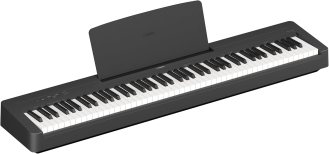
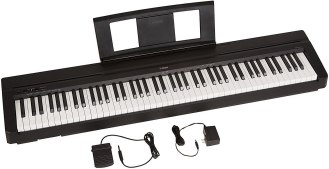
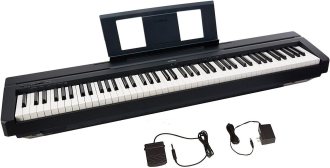
Yamaha P145BT 88-Key Digital Piano
Best for Learning Piano
Dimensions: 10.55" D x 52.21" W x 5.08" H | Weight: 24.5 lb | Connectivity: Bluetooth | Weighted Keys: Yes | Pedals: 1
Yamaha makes top-notch musical instruments up and down its product range, and the Yamaha P145BT Digital Piano is no exception. If you want the sound, power and feel of a grand piano at a fraction of the size and cost, this is the digital keyboard for you.
Like other models in Yamaha’s digital piano lineup, the Yamaha P145BT features weighted, touch-sensitive keys. This allows the keyboard to sound and act like a real acoustic piano, with sounds getting louder or softer depending on how hard or fast you press the keys. It also has an electronic resonance processor that helps simulate the presence and musicality of a Yamaha grand piano. It has built-in speakers with a 13-watt amp to project sound throughout a room, or you can connect headphones via a jack or Bluetooth.
The Yamaha P145BT can be split into two virtual keyboards and hook up to mixing or recording equipment. It has 10 alternate tones for variety, but while it comes with a sustain pedal and a music stand, a keyboard stand or base is not included.
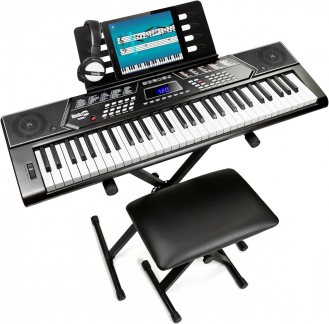
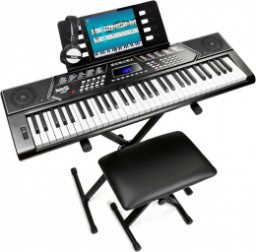
RockJam RJ5061 61-Key Keyboard Piano Kit
Best Beginner Keyboard Bundle
Dimensions: 11.2" D x 36.8" W x 3.1" H | Weight: 7.28 lb | Connectivity: Headphone jack | Weighted Keys: No | Pedals: None
If you have a child who wants to start learning piano and keyboards, you could do worse than the RockJam RJ5061. While it won’t fool anybody into thinking it’s a professional digital keyboard, it’s compact, affordable and fun, and comes with a stand and bench, to boot.
The RockJam RJ5061 is a 61-key digital keyboard with 200 tones in its library, plus 200 rhythms for built-in backing. From its library, it can sound like a grand piano, an organ, a guitar or even orchestral sounds, like a string section or brass.
It comes with a folding stand and a roomy bench as well, so you’re ready to go right out of the box. You can record and play back music with a USB interface and practice privately with a headphone jack.
The RockJam isn’t a full-fledged digital piano. With only 61 keys, it can only play five full octaves, compared to seven on a true 88-key piano keyboard. The RockJam’s keys aren’t weighted or sensitive, either, so there’s no sense of velocity, touch or inertia. But for exploring keyboard music without breaking the bank, it’s a worthwhile choice for beginners.
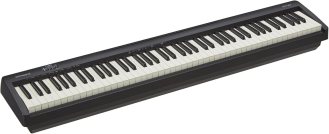
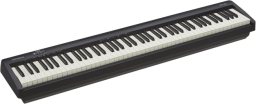
Roland FP-10 88-Key Entry-Level Digital Keyboard
Best Key Action Under $500
Dimensions: 54.5" x 16” x 11" | Weight: 27 lb | Connectivity: Bluetooth, USB | Weighted Keys: Yes | Pedals: Yes
If you’re a novice player looking for an affordable keyboard to practice your craft at home, the Roland FP-10 88-Key Entry-Level Digital Keyboard can help you improve. This entry-level model has a SuperNATURAL piano engine that delivers rich sound and hammer-action keys for responsive feedback.
The integrated speakers and stereo jack allow for private practice sessions, and Bluetooth connectivity means you can connect with compatible apps, DAWs and Roland’s Piano Partner 2 app to help you learn and improve. It’s compact and portable, making it easy to transport, and features real ivory-textured key surfaces for an immersive experience similar to playing on a piano.
Whether you’re a beginner or an experienced musician looking to improve your skills, the Roland FP-10 88-key Entry Level Digital Keyboard is a terrific budget-friendly option. Teachers can take advantage of Twin Piano mode to teach more efficiently, and the system is ready to go right out of the box.
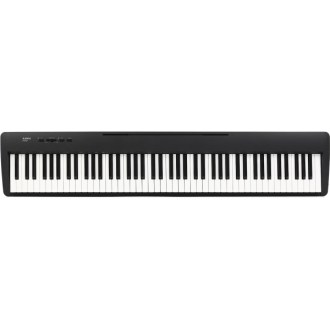
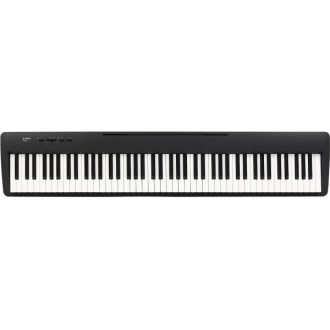
Kawai ES60 88-key Digital Piano
Best-Sounding Tone
Dimensions: 10.25” D x 55” W x 6” H | Weight: 24.25 lb | Connectivity: USB | Weighted Keys: Yes | Pedals: None
If you want a digital keyboard with the feel of a real piano but don’t want to spend too much or bother with a lot of extras, consider the Kawai ES60 88-key Digital Piano. It has the weighted, touch-sensitive keys that serious piano students look for, with additional tones and polyphony.
The Kawai ES60 features a full-sized 88-key board with weighted, touch-sensitive keys, allowing it to respond to playing speed, pressure and nuance. It replicates the sound of Kawai’s Shigeru Kawai SK-EX concert grand piano, with 192-note polyphony for intricate detail, and can also reproduce the tones of an electric piano, organ, strings, and bass. It has a USB audio interface for recording or hookups, and a headphone jack for private practice.
The base ES60 model doesn’t come with very many accessories. Notably, you have to buy a compatible pedal, such as a sustain, yourself. Like other serious digital pianos, there’s no stand or bench either.
Casio CT-S300 61-Key Premium Keyboard Pack
Best Bundle for Students
Dimensions: 46.2” x 15.8” x 5.8” | Weight: 7.26 lb | Connectivity: USB, headphone jack | Weighted Keys: No | Pedals: No
An ideal digital keyboard bundle for students, the Casio CT-S300 61-key Premium Keyboard Pack lets them learn fingering, posture and hand independence without needing the investment of a traditional piano.
The bundle includes the five-octave Casio CT-S300 digital keyboard itself, with 400 tones to play with and 77 built-in rhythms, plus a pair of Samson wired over-ear headphones and an On-Stage KS7190 single-X folding keyboard stand.
Although the Casio CT-S300's keys aren't quite the same as that of a true piano or higher-end digital keyboard, they are touch-sensitive and help approximate some of the dynamics of a real keyboard instrument. For fun, there's a pitch wheel and a USB-MIDI interface, and there's compatibility with an app for smartphones and tablets, and portability is a cinch with the large built-in handle. This bundle lacks a sustain pedal, however, but otherwise it's a great starter keyboard for budding musicians.
Yamaha P71 Weighted Action Digital Piano
For That Acoustic Piano Feel
Dimensions: 52.25” x 12.75” x 15.25” | Weight: 25 lb | Connectivity: USB, headphone jack | Weighted Keys: Yes | Pedals: Yes
The feature-packed Yamaha P71 88-Key Weighted Action Digital Piano features 10 sounds to select from, with many of them sampled from legendary Yamaha grand pianos and synthesized using Yamaha’s Advanced Wave Memory sound engine for incredible realism.
You can layer two sounds together at the same time, letting you experiment with your music in ways that most digital pianos at this price range don’t allow for. A 1/4-inch headphone jack lets you play quietly, and the instrument’s 88 keys employ the company’s Graded Hammer Standard, which makes the lower keys heavier than the higher ones, just like on an acoustic piano.
The lack of a separate audio output limits the piano’s usage when it comes to stage performance, but a USB port lets you plug it into your computer for controlling other digital instruments via MIDI. It comes with a sustain pedal, power adapter and music stand.
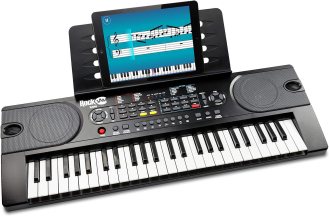
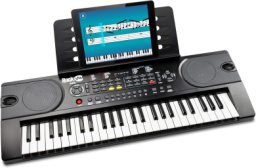
RockJam RJ549 49 Key Keyboard Piano for Beginners
Best for Beginners
Dimensions: 9.25" D x 27.48" W x 3.31" H | Weight: 3.66 lb | Connectivity: Headphone jack | Weighted Keys: No | Pedals: None
The RockJam RJ549 can be considered a bridge between a child’s musical toy and a real digital keyboard. It’s small, lightweight and full of enjoyable capabilities and effects, which makes it a great learning keyboard before shelling out for a “real” digital piano.
With 49 keys spanning just four octaves, no one will mistake the RockJam RJ549 for a serious instrument — but neither is it a toy. It has powerful built-in stereo speakers, 10 different instrument sounds, built-in rhythm and percussion, and an included music stand. It weighs less than 4 pounds, making it easily portable even for grade-school kids to set on a desk, coffee table or carry from room to room.
There are no pedals or other accessories for the RJ549 beginner piano, but that’s not what it’s for. It’s a learner’s keyboard designed to make piano practice fun. As such, it’s got sticker labels to remember the notes of each key, and there’s a learning app for Android and iOS devices. Thankfully for parents, it also has a headphone output.
Yamaha P45B 88-Key Portable Digital Piano Keyboard
Intuitive Design
Dimensions: 11.61" D x 52.2" W x 6.06" H | Weight: 25.35 lb | Connectivity: USB | Weighted Keys: Yes | Pedals: 1
The Yamaha P45B is a simpler but equally refined digital piano with weighted keys and touch sensitivity. If you don’t foresee yourself needing a wireless Bluetooth connection to headphones, and want a little flexibility in the tones your digital keyboard can play, this model may be just what you need.
Like its siblings, the Yamaha P45B’s biggest asset is its weighted keyboard. This gives each key the feel and response of a real piano key, responding to light or heavy touches and finger speed. The P45B has a small library of alternate instrument tones to choose from as well, including electric piano and organ, but its main voice is its finely sampled Yamaha Grand Piano tone.
The P45B, like other Yamaha digital pianos, is a little thicker than you’d expect, so it’s best to set it on a dedicated stand, which you have to buy separately. It comes with USB connectivity for recording and MIDI control, and it has an included sustain pedal.
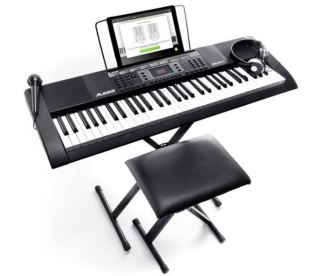
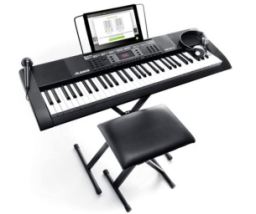
Alesis Melody 61 MK4 61-Key Piano Keyboard Bundle
Feature-Packed
Dimensions: 9.12" D x 36" W x 2.88" H | Weight: 6.61 lb | Connectivity: USB, headphone jack | Weighted Keys: No | Pedals: None
An all-in-one package deal, the Alesis Melody 61 includes all you or your child might need to explore keyboard playing and music. It’s more an arranger’s first keyboard, and at this price, with these extras, it’s sure to please learners and hobbyists of all ages.
Alesis makes a respected, high-quality range of digital keyboards and digital pianos. The Melody 61 is firmly in the first category, with an expansive library of 300 sounds, 300 rhythm accompaniments and 30 demo songs. The sounds can be layered or split, with sustain and vibrato effects available at the push of a button. At less than 7 pounds, it’s easy to take from room to room.
The package contributes to the value. You get an adjustable keyboard stand, a bench, music stand and even a pair of headphones to keep tunes private. The lack of weighting and touch sensitivity means it doesn’t feel like a real piano, but it’s not intended to.
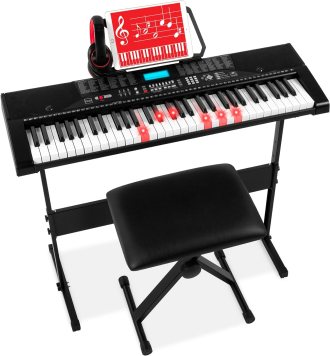
Best Choice Products 61-Key Beginners Complete Electronic Keyboard Piano Set
Easy Assembly
Dimensions: 36.4" D x 12" W x 3.7" H | Weight: 17.2 lb | Connectivity: USB | Weighted Keys: No | Pedals: None
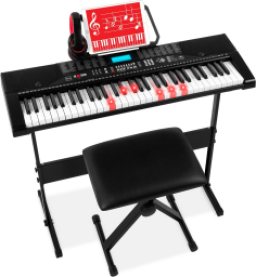
This Best Choice Products Beginners’ Keyboard is a good buy if you don’t want or need to invest in a major purchase. If what you want is to wow a child with a complete first digital piano set, this is a solid option, with light-up keys and several fun colors.
Like other beginners’ digital keyboards, this Best Choice Products model isn’t meant to reproduce the touch and feel of a real piano. Rather, it’s meant to combine fun with learning to play, especially with its light-up keys that help a novice player know which key to press and when. Note stickers help new learners remember which key is which note as well.
The Best Choice keyboard’s 61 keys covers about five octaves, but it’s packed with 255 tones and rhythms, 32 percussion options and 50 demo songs. Its H-style stand looks stylish compared to X-stands, and it comes with a bench and headphones. Body color options include red, pink, blue and white as well as black.
How we analyzed
We analyzed our picks based on several criteria, most importantly distinguishing between synthesizer or arranger style keyboards and dedicated digital pianos. We looked at size and weight, important for portability, as well as number of keys, which decides the number of playable octaves.
For beginner keyboards, we looked at accessibility, number of alternate instrument tones, headphone output and guided learning. For digital pianos, we focused on weighted or hammer-action keys, touch sensitivity, polyphony and the kind of acoustic piano sampled. We noted as well the presence of accessories, such as a stand, a pedal, a bench and a music stand or holder.
Traditional or experimental use: You decide
When shopping for a digital keyboard, there are essentially two paths you can take.
Some people seek an instrument that duplicates the performance of a traditional keyboard, such as a piano or organ. Others seek a multifunctional synthesizer with more advanced capabilities.
- A digital keyboard with 88 weighted keys and sustain pedals is ideal for student rehearsal or professional practice.
- A small synthesizer with fewer spring-loaded keys is generally better for recreational use.
Digital synthesizer advantages
Modern digital synthesizers include functions and features that allow players to perform in ways that traditional keyboards can’t accommodate.
- With the press of a button, you can launch a sophisticated rhythm track complete with bass variations, drum fills and intro/outro options.
- On some keyboards, you can press a button that automatically adds the appropriate chords to a single-note performance.
- Synthesizers often include digitally sampled voices that can mimic a saxophone, string orchestra or horn section instantly.
Traditional keyboard advantages
More basic digital keyboards may not be as versatile as synthesizers, as they are primarily designed to function as alternatives to acoustic pianos.
Many music students don't have easy access to traditional upright or classical pianos. Digital keyboards offer an affordable solution that duplicates the action and touch of a real piano, including weighted keys and sustain pedals.
- Some models have additional voices that lean into classical sounds like organs, brass instruments or strings.
- Because traditional keyboards are focused primarily on pianists, they tend to offer a more realistic feel to their keybeds than synthesizers.
- These instruments may not include rhythm tracks or automatic chord programs, but they work well as in-home rehearsal instruments for both students and those interested in pursuing music at a professional level.
Action
Traditional piano keys are mechanical levers. The player depresses a key that engages an internal hinge and hammer. The hammer strikes the piano's tuned wires, creating a note. A cloth damper then presses on the string and ends the vibration. This design puts weight on the keys, and piano students eventually develop a performance technique based on that resistance.
A digital piano doesn't have hammers, so it relies on internal technology to simulate the action of an acoustic instrument. Poor action can cause a player to develop a playing technique that may not translate well to an acoustic piano. For the best, most expressive learning and playing experience, choose a keyboard with realistically weighted keys.
Touch sensitivity
Touch sensitivity takes the concept of “action” one step further. A touch-sensitive keyboard allows the player to convey the emotion of the music by depressing keys with varying amounts of pressure and velocity. Many digital keyboards have special sensors that measure the amount of pressure and speed performers place on each key. A lighter touch results in a softer tone, while a heavy or fast touch creates a louder note with a faster “attack.” This is a useful feature during performance since part of what makes music interesting to the listener is a change in dynamics.
Digital keyboard features
Some digital keyboard manufacturers like to pack as many additional features as possible into their high-end models, but shoppers should avoid the temptation to upgrade without cause.
There are additional features that enhance or improve performance, but there are also add-ons that casual users don’t need. Composers may want to create and store original tracks, for example, but most players, rehearsing the work of others, will not.
Sustain pedals
An important element of performance is the ability to sustain a note or chord for a long time or close it off immediately.
Traditional pianos accomplish this through the use of foot-operated sustain pedals. These pedals move the dampening board closer to or further from the piano's strings.
Many digital keyboards designed for rehearsal offer all three pedals, but others offer only one pedal as an add-on feature.
Outgoing ports
Digital keyboards should have the capability to communicate with the outside world through external ports. The two most important features to look for are an external headphone/amplifier jack and a MIDI connector.
The onboard speakers on most digital keyboards, even on the higher end, can only produce a limited amount of sound, so the synthesizer needs the ability to connect with a mixing board or powered amplifier rated for keyboards. Budget keyboards may only include a single headphone jack. If you plan to amplify your sound or perform publicly, look for an instrument that includes a more robust 1/4-inch jack dedicated to external output.
MIDI implementation lets you use your keyboard to control an almost limitless number of digital instruments via your computer. Most digital keyboards feature MIDI via USB.
Pitch bend controller
One very useful addition, especially in terms of performance, is a pitch bend controller. Usually found on the left side of the keyboard, a pitch bend wheel is a spring-loaded switch that can “bend” a note several tones above or below its original setting.
Using a pitch bend wheel on an electronic keyboard can improve the authenticity of a voice’s sound.
Pitch bend wheels are only found on synthesizers, as the use of this feature is not a part of traditional piano playing.
Polyphony
A keyboard's polyphonic capacity reflects the number of pitches that can be held and/or sustained at the same time. Once a keyboard reaches its polyphonic maximum, the pitches begin to cancel each other out. In general, the higher the polyphony, the better. Most modern digital keyboards allow for 128 voices of polyphony.
Information on amplification
When used as an in-home rehearsal instrument or recreational synthesizer, volume isn't usually a major consideration. The onboard speakers should deliver enough power to fill a small room with sound.
However, there are times when a home digital keyboard may have to fill some much larger shoes. Under these conditions, even the most expensive synthesizer speakers could be drowned out by other instruments or lost in the expanse of an auditorium. This calls for serious amplification.
Use a wireless lavalier microphone
There are times when a wired instrument can be a safety hazard to others, or a small sound system has no available channels. One low-tech solution is to attach a wireless lavalier microphone to one of the keyboard's external speakers and mix it into an existing channel with a wireless receiver. The keyboard and player can be positioned anywhere within the microphone's range, and the sound can be balanced through the mixing board.
Feed the keyboard into a mixing board or pre-amp
A safer solution for keyboard amplification is to plug the piano into a mixing board first and then adjust the channel to the proper balance. This is a workable solution for church and performance halls where the player can hear other musicians and the keyboard through monitors or PA speakers. An experienced sound mixer should be able to monitor the keyboard's channel and keep everything in balance.
Plug into a powered keyboard amplifier
Manufacturers offer dedicated amplifiers designed to accept the output from a digital piano or synthesizer. Like a guitarist or bass player, a pianist can use an external amp to hear their playing while on stage or make further adjustments to their sound using the amp’s tone controls or built-in effects.
Pros and cons of digital keyboards
Pros
- A digital keyboard is easier to transport than a traditional piano or organ. Even the lightest practice pianos weigh several hundred pounds and are not designed for portability. A music student can install a digital keyboard in a small apartment or bedroom with minimal assistance.
- Digital keyboards rarely require maintenance. The electronic components of a synthesizer are not designed to go out of tune due to atmospheric conditions or rough handling.
- If a digital keyboard does need to be tuned to another instrument, it's only a matter of turning one knob or adjusting a setting.
- You can play a range of instruments with just one keyboard. Acoustic pianos are limited to the tones they naturally create, but a digital keyboard can sound like a horn section, strings, various types of electric pianos and more.
Cons
- Many digital keyboards don't duplicate the action or touch of an actual piano or organ. A lot of smaller keyboards use lightweight plastic keys that are spring-loaded for easier playing. The keys themselves may be smaller in size than traditional keys, and there may not be 88 of them.
- Making the transition from a lightweight digital keyboard to a traditional instrument is often a challenge. Only the most premium digital pianos offer a true duplication of the acoustic experience.
- Digital keyboards only synthesize the voices of instruments; they don’t fully recreate them. Although the original sound source may have been a real instrument, digitizing and synthesizing that sound for a keyboard affects its characteristics.
FAQ
Q. How much does a digital keyboard cost?
A. Budget digital keyboards can cost under $100, but they're limited in functionality and many don’t include 88 keys. Premium digital pianos can cost thousands of dollars but are loaded with technology that most users won’t ever need. The average player should expect to spend $300 to $600 on an instrument that offers a feel and sound close to that of a real piano.
Q. My child just started taking piano lessons. Do I need to buy a practice keyboard with 88 weighted keys?
A. Ordinarily, you would want to match the rehearsal instrument with the performance instrument as much as possible. If your child's instructor uses a traditional piano with weighted keys, then investing in a similar digital keyboard would be best. However, these instruments can be very expensive. For the short term, a younger player just learning the fundamentals of music can practice scales and basic melodies on a smaller keyboard with fewer keys.
Q. How do digital keyboards duplicate the sounds of so many instruments so well?
A. Synthesizing authentic instrumental voices was a major problem with earlier generations of digital keyboards. The few voices featured on these instruments sounded very little like the real thing. But the invention of digital sampling software revolutionized the industry. Sound engineers recorded real musicians performing on real instruments under laboratory conditions.
Q. Why does my new electronic keyboard sound so tinny? I like to play it for fun, but the sound isn't very good.
A. Even digital keyboards on the higher end of the price range tend to have speakers that aren’t great quality, especially at high volume. You can increase the loudness and fullness of your sound by running it into an external amplifier or speaker that's more suited to higher output.
That said, the sound quality of the samples included in many budget keyboards usually sound dated and unrealistic upon close inspection, regardless of what they’re played through.